


Knowing Where Your Money Goes Is the First Step to Controlling It
Key takeaways
- Healthcare costs are projected to rise 9.4% from 2026 to 2027, adding $1,848 per employee per year. Will the company absorb it, or will employees pay for it out of their paychecks?
- To control costs, CFOs and business leaders must begin with the biggest line item: the cost of medical services themselves.
- By understanding the components of medical costs, targeted steps can be taken to control costs while preserving appropriate care for employees.
The Email That Changes the Budget
Picture a CFO finishing the 2027 strategic plan. Revenue targets, headcount, and budgets are set, and the board deck is almost done. Then the benefits renewal arrives... with a 9.4% increase in healthcare costs.
Total healthcare cost for the company's 1,000 employees and their families was $19.6 million in 2026,1 with the company paying 80% and employees 20%.2 The 2027 projection is $21.4 million. Even at the same 80% share, the company's cost rises by $1,478,400, roughly $1.5 million of new expense.
The first reaction is the one most executives have: What, if anything, can I do about this? It feels like a black box that goes up every year.
So the CFO faces three uncomfortable choices:
-
Absorb it. Taking on the full increase costs the company $1,848,000 more per year.
-
Push it to employees. Every dollar the company doesn't absorb comes out of employees' paychecks. If the company passes the entire increase along, each employee pays $1,848 more per year out of their own pocket.
-
Cut benefits. Reduce benefits or narrow access to care.
None of these makes care cost less; they only decide who pays. But a proactive CFO can take steps to control the underlying cost while protecting access to quality care. It starts with understanding what you are actually paying for.
Tackle the Biggest Problem First
When faced with a challenge this big, the best approach is to break it into its component parts and tackle the largest ones first. Here, the largest piece is medical claims: $13,740 per employee per year, or 64.1% of total healthcare expense.3
Medical claims are the single largest line in the entire plan. So let's open that bucket.
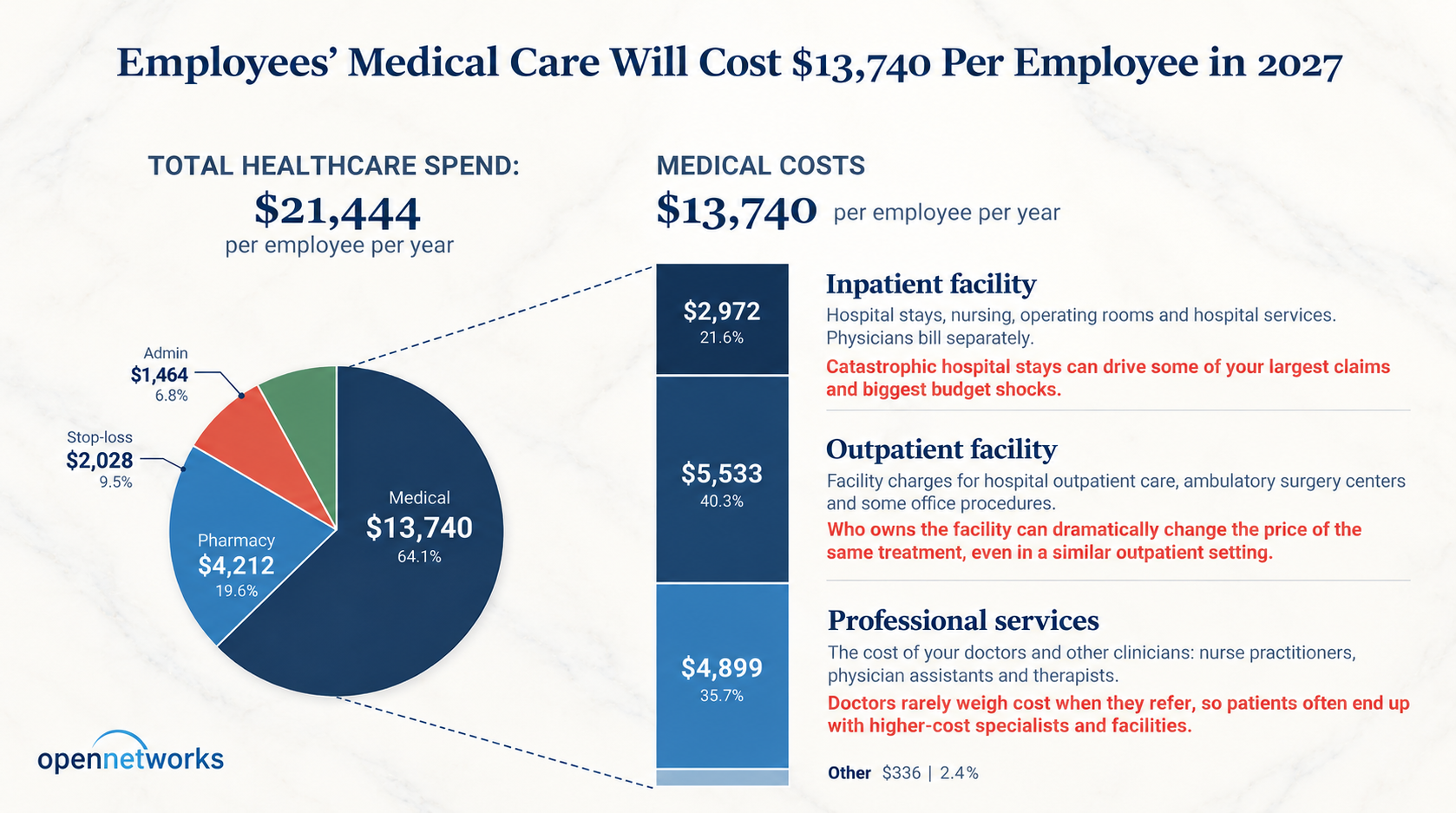
Inpatient Facility Costs: $2,972 per Employee per Year
This is what you pay the hospital when someone is admitted: the room, the nursing care, the operating rooms, and other hospital services. The doctors who treat the patient bill separately, under professional services.
At 21.6% of medical spending, inpatient is the smallest of the three major categories. But the average hides the amount of risk. Most employees will never be admitted in a given year; a few will have stays that cost more than everyone else's care combined. And when someone is admitted, the hospital's bill is most of the cost. One large study of 6.7 million inpatient admissions found that, on average, the costs broke down to roughly 82% for the facility and 18% for professional fees (physicians and other healthcare workers).4
Catastrophic hospital stays can drive some of your largest claims and biggest budget shocks.5 Think of an employee hospitalized for weeks after a serious accident or illness, or a baby born very early who needs care in a neonatal intensive care unit (NICU) for weeks or months.6 These are your employees and their families going through the hardest moments of their lives. They need excellent care. The point is not to withhold it; the point is to understand that a small number of these cases can move your whole budget.
Outpatient Facility: $5,533 per Employee per Year
This is the largest medical category, at 40.3% of medical spending. It covers facility charges for care outside a hospital stay: hospital outpatient departments, emergency rooms, ambulatory surgery centers, and hospital-owned doctors' offices that bill like one. A facility charge pays for the space, equipment, and staff, separate from the doctor's fee.
For the right procedures and patients, outpatient care is often as good or better. In joint replacement, studies show the same or lower complication and readmission rates (1.2% versus 3.2% total complications)7, 8 at 20% to 30% lower cost.9
Here is the part most purchasers of healthcare never see: who owns the facility can dramatically change the price of the same treatment.
Hospital outpatient departments can cost significantly more than freestanding surgery centers for the same procedure. A Health Affairs study of more than 31,000 commercial contracts found 13 common procedures cost an average of $1,489 (78%) more in hospital outpatient departments,10 and Blue Cross Blue Shield data show those prices rising 27% from 2017 to 2022, versus 11% at surgery centers.11 Chemotherapy, immunotherapy, and infusions for conditions like rheumatoid arthritis are often performed at outpatient facilities, and the site matters: annual cancer drug costs averaged $196,000 in hospital outpatient settings versus $128,000 in independent physician offices.12
Insurers increasingly own outpatient facilities too. UnitedHealth's Optum operates more than 370 surgery centers,13 and Independence Blue Cross is co-developing at least 18.14 Evidence suggests this ownership can raise prices for everyone else: after Optum bought 24 surgery centers, prices paid by competing insurers rose 11%, about $239 per procedure.15, 16
Professional Services: $4,899 per Employee
These are the bills from doctors and other clinicians, including nurse practitioners, physician assistants, and therapists, for care they provide in an office, a hospital, a surgery center, or by telehealth.17 They also include lab tests, imaging, and drugs administered in a doctor's office. They make up 35.7% of medical spending (excluding pharmacy) in our model.
Referring physicians give little weight to cost. In a systematic review, cost never ranked among their top five factors in choosing a specialist,18 and only a third of their cost estimates came within 20% to 25% of the actual cost.19 Claims data agree: primary care physicians showed essentially no sensitivity to surgeon costs,20 and patients bypassed an average of six cheaper providers to get the same MRI.21 But when physicians in one trial received cost information and had a reason to use it, their cost per referral fell 45%, at least at first.22
Something to be aware of: the owner of your primary care physician's practice can steer referrals toward higher-cost specialists and facilities, rather than lower-cost alternatives. When a hospital system or a large corporate group owns the practice, there can be financial and organizational pressure to keep referrals inside its own network.23 That does not mean every referral is wrong. It does mean that who owns your employees' doctors is worth knowing.
The scale of ownership can be surprising. At its peak, UnitedHealth Group's Optum had employment or affiliation relationships with roughly one in ten U.S. physicians.24
Other Medical Services: $336 per Employee
The remaining 2.4% covers home healthcare, ambulance rides, durable medical equipment, and prosthetics.25 These matter to the people who need them, but they are not where the money is.
Understanding Is the First Step
Let's go back to our CFO with the $1.5 million increase. There is still a hard decision to make. But healthcare no longer has to be a black box. Our CFO now knows that three quarters of the company's medical spend sits in outpatient facilities and professional services, and that the price of the same care can change depending on where it is delivered and who owns the place delivering it.
That is the foundation for the solution. Cost shifting and benefit cuts are not the only levers available, and the goal is not simply a lower number. The goal is a plan where costs are under control and your employees and their families can get good care that keeps them healthy, or helps them get healthy.
In future posts, I will dig into the specific opportunities in each of these areas, and into the other parts of the plan, including pharmacy.
Neal Kaufman is the Chief Strategy Officer and CFO of OpenNetworks Health.
Notes
-
Model. Illustrative model for a 1,000-employee self-funded company, carried over unchanged from Healthcare Costs Are Rising Sharply. Do You Know Where Your Money Goes? Gross plan cost rises from $19,596 per employee in 2026 to $21,444 in 2027 (+9.4%). This post assumes an 80% employer / 20% employee funding split: employer cost rises from $15,676,800 to $17,155,200 (+$1,478,400); employee payroll contributions rise $369.60 per employee. Medical starts from a $1,050 PEPM planning baseline trended +9% to $13,740 per year. Category splits allocate that total using the relative 2026 category costs and trends in the 2026 Milliman Medical Index. This is a teaching model, not any specific employer's bill.
-
KFF 2025 Employer Health Benefits Survey. The 80/20 split is in the range of what large employers actually do: workers at large firms contribute about 16% of the premium for single coverage and 23% for family coverage. These shares are of premium only and exclude deductibles, copays, and coinsurance.
-
In my previous post, I split annual per-employee healthcare spend into three buckets: claims ($17,952), stop-loss insurance ($2,028), and administration ($1,464). Claims are the care employees and their families actually receive, and they come in two pieces: medical ($13,740, or 76.5% of claims) and pharmacy ($4,212, or 23.5% of claims).
-
Peterson et al., "Professional Fees for U.S. Hospital Care, 2016 to 2020," Medical Care, 2023. Adjusted mean ratio of total to facility-only payment of 1.224; the 82/18 split is derived from that average and varies by diagnosis.
-
MedlinePlus, Neonatal intensive care unit; Voya, Stop-loss insurance.
-
Ponugoti N, Magill H, "Safety, efficacy and cost-effectiveness of outpatient versus inpatient joint arthroplasty: a systematic review and meta-analysis," BMC Musculoskeletal Disorders, 2025.
-
"Inpatient vs outpatient arthroplasty: An in-state database analysis of 90-day complications".
-
Patel et al., "Procedure Cost Comparison of Outpatient and Inpatient Shoulder Arthroplasty and Lower-Extremity Arthroplasty Within a Managed-Care Organization," The Permanente Journal, 2022. Single-center study of 300 procedures; outpatient surgery cost 20% (reverse shoulder) to 30% (knee) less than inpatient.
-
Brown University researchers, "Commercial Insurers Paid More For Procedures At Hospital Outpatient Departments Than At Ambulatory Surgery Centers," Health Affairs, October 2025; summary in Becker's Payer Issues. 2024 prices from UnitedHealthcare, Cigna, and Blue Cross Blue Shield plans.
-
Blue Cross Blue Shield Association / Blue Health Intelligence, "Hospital outpatient prices far higher, rising faster than physician sites". Commercial claims for 123 million members, 2017 to 2022.
-
UnitedHealth Group, Administered drugs analysis, April 2026.
-
ASC News, "UnitedHealth's Optum Wants to 'Go Deeper' in Surgery Center Markets," October 2026.
-
Becker's ASC, "Should payers own ASCs?" October 2026. Independence Blue Cross, Penn Medicine, and Regent Surgical jointly own the new venture.
-
Lake DT, et al., "Strategic Selection and Pricing Power: Optum's Acquisitions of Ambulatory Surgery Centers and Physician Practices," Health Affairs, February 2026. Commercial claims from 2015 to 2018 for seven high-volume procedures, excluding UnitedHealthcare.
-
Becker's Payer Issues, "Optum's provider acquisitions tied to price increases for rival insurers: Study", February 2026.
-
Finn CB et al., "How Referring Providers Choose Specialists for Their Patients: a Systematic Review," Journal of General Internal Medicine, 2022.
-
Allan GM, Lexchin J, "Physician awareness of diagnostic and nondrug therapeutic costs: a systematic review," International Journal of Technology Assessment in Health Care, 2008.
-
Brot-Goldberg ZC, de Vaan M, "Intermediation and Vertical Integration in the Market for Surgeons," working paper, 2019. Commercial claims for orthopedic referrals in Massachusetts.
-
Chernew M, Cooper Z, Larsen-Hallock E, Scott Morton F, "Physician agency, consumerism, and the consumption of lower-limb MRI scans," Journal of Health Economics, 2021.
-
Barkowski S, "Does knowing the costs of other physicians affect doctors' referrals?" Journal of Health Economics, 2025. Field experiment on ophthalmology referrals; the effect faded over the following four months.
-
Health Services Research, physician integration and referrals.
-
Becker's Hospital Review, October 2025. Includes employed and affiliated physicians as of 2023; Optum has since reduced its affiliated network (Becker's, March 2026).